
Greece and Rome
Basilikón, the Herb of Kings
Its Greek name evokes what is royal. Theophrastus, Dioscorides, and Pliny are among the ancient authors who wrote about basil.
Inside the ManorLeaf archives

3 min read

Often reduced to its role in the kitchen, basil (Ocimum basilicum) is nevertheless one of the most historically charged plants of the Mediterranean flora. A true crossroads between table and apothecary, it has accompanied humanity since antiquity, both for its culinary uses and for its long-standing place in herbal traditions.
Common basil stands out for its highly aromatic leaves, rich in volatile compounds. It is best known in the kitchen, but medicinal traditions also used it for the belly: slow digestion, gas, mild cramps, and discomfort after meals. Its strength is not to act forcefully, but to help release what contracts.
Basil has carminative, antispasmodic, and mildly anti-inflammatory properties, and is mainly used to support simple digestive troubles. Its aromatic molecules, such as linalool and eugenol, contribute to its relaxing effect on the smooth muscles of the digestive tract. Rosmarinic acid supports its antioxidant profile and explains part of its traditional use on minor irritations.
The genus Ocimum counts more than seventy species spread across the world. Some of these plants were emblems. Here is how four civilisations lived with them.
Greece and Rome
Its Greek name evokes what is royal. Theophrastus, Dioscorides, and Pliny are among the ancient authors who wrote about basil.
India
Holy basil, distinct from culinary basil, remains a devotional plant closely associated with Vishnu.
Haiti and the Caribbean
In leaf baths and some Vodou rites, the plant belongs at once to care, symbol, and the spiritual world.
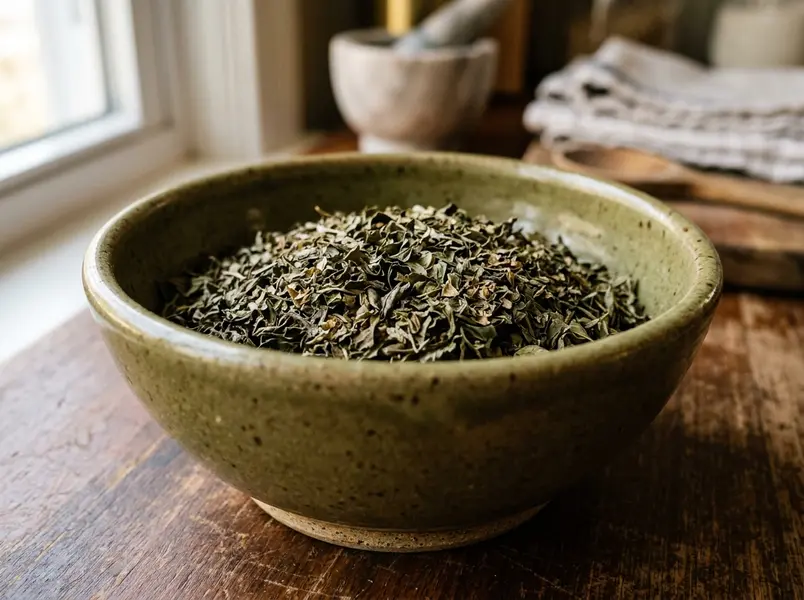
Infusion remains the simplest way to enjoy basil outside the kitchen. Let a small handful of fresh leaves, or one teaspoon of dried leaves, steep for 5 to 8 minutes in water around 85 °C. Cover the cup to preserve the aromas.
The leaf mainly contains volatile compounds — linalool, eugenol, methyl chavicol — as well as polyphenols such as rosmarinic acid, linked to its digestive, antioxidant, and soothing action.
Pliny the Elder. Natural History, Book XX.
Dioscorides. De Materia Medica, Book II (1st century).
Boccaccio. Decameron, Day IV, Tale V (c. 1353).
Parkinson, John. Theatrum Botanicum (1640).
Culpeper, Nicholas. The English Physitian (1652).
Grieve, Maud. A Modern Herbal (1931, reissued 1971).
Wood, Matthew (2008).
The Earthwise Herbal — A Complete Guide to Old World Medicinal Plants
. North Atlantic Books.
Cohen, M. M. (2014). « Tulsi — Ocimum sanctum: A Herb for All Reasons. » Journal of Ayurveda and Integrative Medicine, 5(4), 251–259.
Azizah, N. S., et al. (2023). « Sweet Basil ( Ocimum basilicum L.) — A Review of Its Botany, Phytochemistry, Pharmacological Activities, and Biotechnological Development. » Plants, 12(24), 4148.
Filip, S. (2017). « Ocimum basilicum L. — A Review on its Chemical Constituents and Pharmacological Activities. » Differential Nutrition-Health Properties of Ocimum basilicum, PMC9222536.
Padma Purana; Devi Bhagavata Purana (classical Vedic texts).
Greek Orthodox Archdiocese of America — Exaltation of the Holy Cross (liturgical tradition).
ReVista, Harvard DRCLAS — « The Coolness of Cleansing: Ritual Baths in Haitian Vodou. »